2/08/2011

The First Harbinger in Our "Garden"

I have a lot to tell but at this time of year let's begin with the most important – at least for me: the first Eranthis hyemalis flower opened yesterday on our balcony. I realized the little yellow spot only after some lingering around that pot!


So I decided to cut down the dried leaves of the Campanula raddeana. They were left for winter to protect the sleeping buds of Hepatica nobilis (and also of different bulbs resting in that pot):

Buds of Hepatica nobilis
Here is after the haircut (picture taken yesterday afternoon with flash):


The long ribbons are the leaves of autumn flowering Sternbergia lutea.

Today was sunny and warm (14°C), so the Eranthis flower opened. It is obvious from the following picture how much it resembles to the hellebore flower.


Both have the petals transformed to nectaries, and the sepals taking the role of the petals. Both have many anthers, of the same shape. But the hellebores have 5 sepals which remain on the flower after flowering, the Winter Aconite (Eranthis) has more sepals which fall down after pollination. And the Eranthis has those pretty bracts looking like collars around the flower.
Both belong to the Helleboraceae family. As I know they were the same genus (Helleborus) some time ago. Winter Aconite is also called Winter Hellebore.

I observed in the sunshine that the Caryopteris has already little new leaves:

Caryopteris x clandonensis 'Heavenly Blue'
I got it last autumn and I wondered if it would be hardy in a pot. It seems like it was. I have to cut it down soon, and also to put it in a larger pot.

________________________________________________________________________________

Seed sowing

Yesterday I sowed the seeds got from the SRGC. I got the packet in middle January but I simply did not feel like to sow them (it happens sometimes to me!). So I put them in moist vermiculite in zip lock bags, than in paper bags and put outside on the frosty balcony.


I like vermiculite for seed storing and layering. I've heard that it was good also for the ephemeral seeds to preserve germinating capacity.
I used to pour it dry in the bag, then put the seeds, mix it, and then spray into the bag 3 times with water, the mix to be just moist. Then lock the bag and put it in the fridge or outside.
When sowing, I pour all the contents of the bag on the moist composts' surface, than cover it with some grit.
Here is yesterdays' sowing:


They go to the garden to be subjected to the whimsy weather. (Don't forget: these are alpine plants' seeds, not tropicals or vegetables!)

There are also some bulbous plants' seeds, like Crocus banaticus, Scilla greilhuberi, Merendera montana, Fritillaria sp. and Allium sp. collected in Asia, which are in water now to soak. They will be sown tomorrow.


________________________________________________________________________________

Bulb blue

I have to turn again to the recently shown forced bulbs. There was a narcissus bulb which has very few roots. Well, it made only one flower and the leaves remained small. Now the tips of the leaves are yellow/brown:


I learned from Ian Young that this meant the bulb was beginning to rot.
I pulled it out easily from the compost because those few roots are almost all gone:


Cutting the bulb in two, can be seen the spots where the rot begun:


It's fantastic that you can see this on the leaves!

The forecast says that winter comes back by the end of February, but today I gave some water to our miniature alpine gardens. If the alpines feel that winter is over, they begin to assimilate and need water for that. If the weather is not favourable, they just stop growing but don't die, because the sap is already moving in their body, and the new season's life is irreversible.
Welcome, new season's life!

1/27/2011

Distorted Tulips

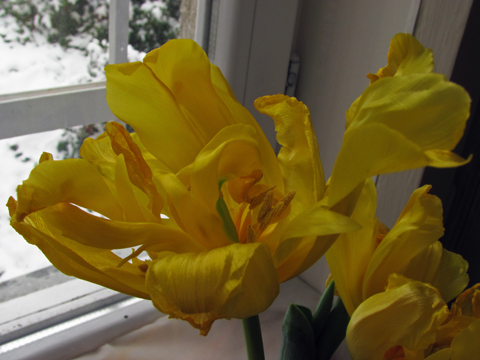
The tulips shown in my latest post have opened, but they all have distorted flowers.


As I know, also virus infection can cause flower distortion, but it can be that it simply went something wrong with the forcing.

On a closer picture you can see that there are too many stamens. Even more, some of them can not decide whether to be stamen or tepal...


And also the style is transforming into tepal:


There is no problem with the Narcissi, the flowers are opening one after the other. The first ones are already fading, here is too hot (20°C) for flower longevity. I like Narcissi flowers because they are just drying instead of wilting like other plants' flowers.


Winter is back again, on the left side of the above picture there is a ribbon of the snowy garden.


1/19/2011

Forced Bulbs

Yesterday I got two pots with bulbs from my husband so I thought it was time to write about the technology of forcing bulbs. Though my experiences are not too fat but I have also some knowledge acquired at the Corvinus Horticultural University of Budapest.

Here they are: Narcissus 'Tête-à-Tête' and Tulipa 'Sans Nom' (just kidding, the latter has no name).

At this time of year the flower shops are full of flowering tulips, narcissi and hyacinths, put 2-3 in little pots. These bulbs were forced, namely submitted to strict temperature treatment to flower earlier than usual.
There is a complete technology of forcing: how many weeks in what temperature must be stored the bulbs to mimic the nature in an accelerated rhythm. This depends also on species or cultivar: there are some which are excellent for forcing and others which are not at all for this purpose.

To understand the forcing one must know the life cycle of bulbous plants.
This is what happens in mother Nature and in the garden:
The spring flowering bulbous plants of our temperate zone draw back in early summer. After flowering and seed ripening their leaves and roots die back, this is a surviving strategy during the summer draught and heat or the poor light conditions in deciduous woods. But before withdrawing the new bulb forms for next year. This happens with the help of assimilating leaves, so they must be left alone until yellowing to do their job.
During summer the bulb is apparently resting in the soil, but at this time is the next year's flower initiating. There are precise informations available about the sequence of initiation of the different flower parts and the time and temperature needed for each of them. However, the average temperature needed is 20°C. On a bulb cut in two and painted with ink one can see the formed flower parts with a loupe.
In september (or sometimes later) as the soil temperature decreases and rains fall, the bulb makes new roots. The optimal temperature for this process is 9°C.
BUT in this rooted stage the plant in no way can be forced to flower yet!!! It needs some weeks of even lower temperature (about 5°C) for the bud to form and push itself up to the top of the bulb. Then it is ready to flower in adequate conditions. The time needed to spend in 5°C depends on species or cultivar. And this is the essential condition of forcing! This 9°C and 5°C temperature treatment. Right after the flower parts are initiated (this also can be accelerated with storing at defined temperatures) he bulbs are dry stored at 9°C and then at 5°C for limited time – the minimum time needed for the given species. Than the bulb is ready to flower given higher temperatures. It does not even need to have roots! After the 5°C storing, the bulb must be stored onwards at 2°C, to hinder blooming. For good timing of the flowering is essential to keep to the exact temperatures and times needed during the above treatment.
I've learned this at the Horticultural University.
Now my experiences.
I tried to force bulbs of narcissi without the above temperature treatment for Christmas and January – with no results. I potted them up in September, watered and kept outside until early December. Then took them inside in 20°C and watered. They made leaves, but no flowers. The flower bud was probably not yet completely formed, ready to be born, so the baby flower died in the bulb.
But we can make bulbs without temperature treatment to flower much earlier than usual, that is in March instead of May, for example. They must be potted in September, watered well to make roots and then kept on the dry side during the winter to avoid wet rot. This is rather hard, to find the way between not too dry and not too wet, but it is a matter of paying attention. 
Than take it inside in February, firstly in 16°C than in a warmer room, and they will flower. If you take them directly in 20°C room, you must cover them to etiolate, namely the flower stem to grow above the leaves. But be careful, if the temperature too hot the flower wants to open in the bulb already.

Now back to the two (six) plants shown above.
The forcing of dry stored bulbs has a problem (not for the grower but for the customer): the bulbs usually flower almost without roots, so they can not be kept for next years because no new bulb will form.
This time they had roots:

Narcissi

This one had very few, but let's try anyway

Tulips

These roots are very brittle, must be handled with much care. I put them together in a large pot. I will water them and also give some nutrients, rich in K, as I have learned from Ian Young. I hope to have flowers also next year, though not at this time. 


Today opened also the first Narcissus flower:


And another day later:


Burying the Winter?

The Hungarian name of Winter Aconite (Eranthis hyemalis) is "Winter bury(er?)".

On Saturday at noon I had the foolish idea to go and see the Eranthis plants growing on the Hárs Hill, near Budapest. And we were really astonished seeing that the flowers were about to open already. It was a warm and more or less sunny day. Last year we saw them on the same place in March, I wrote about it then. 
There were many other tourists coming along enjoying the spring-like day, but nobody understood what about these two fools on all fours, photographing those yellow flowers.


And the beautiful pictures of my husband can be seen HERE.


1/12/2011

They are Dreaming of Spring

Draba parnassica

Primula clusiana

Primula marginata

Saxifraga bronchialis

Saxifraga federici-augusti subsp. grisebachii

Saxifraga 'Leonardo da Vinci'

1/01/2011

Happy New...

On the first morning of the year we were awoken by this crazy Hawfinch. About half an hour long he (she?) jumped from the windowsill to the feeder and back again, and knocked the windowpane. One jump, one knock-knock. I don't know if he (she?) wanted to get to those plants behind the pane, or to bundle out "that one" which stayed there and stared to him (her) again and again.
Tits come many times and want to get at the plants to search for caterpillars maybe, but they realise rapidly that there is some material they can't get through. But this fool thing wanted in no way to give up. Hawfinch is a quite aggressive bird, it never lets any other to come to the feeder, so I can imagine that he (she?) saw his (her?) image in the pane and thought it was another bird which must be bundled out.

So, I wish a very happy new year to everybody! :)


12/26/2010

"Snowing, Snowing, It's a Fairy Dream" (Hungarian Children's Song)


It's not a dream, it is the rough reality. After a few spring-like days we had a snowstorm last night, so all our balcony is covered with white blanket, not the smallest place remained free. Frosts are forecasted, so I don't remove the snow, let the alpines feel like home at last.


In the "plastic tunnel" it is safe:


12/15/2010

Cyclamen Problems

Pests and diseases are afflicting our Cyclamens and consequently me.
First, de disease, which is only supposed yet.

Two or three years ago I got two Cyclamen graecum tubers from the UK. Somebody wanted to get rid of his Cyclamens, which were down at the heel.  I thought I may try two graecums. I potted them up and admired their beautiful leaves every autumn since then, namely no flowers yet.
This picture was taken in October 2009:

Cyclamen graecum
This year they started to grow rather late and slowly, as I showed in an earlier post, despite of the watering. And finally they pushed some ugly, distorted leaves:


I decided to get out the tubers and look into the compost maybe I could find the reason. But the tubers were healthy, hard, the compost had a good drainage and was just moist, and also the roots seemed to be OK, though they have not grown too much during these years.


Especially this one looks rather odd with so much dead leaves on the top of the tuber, and scarce roots:


I showed the pictures to a friend of mine, he suggested to make also a section of the root to see if there is a fungal disease. It seems like healthy:


I found no vine weevil larvae, which can eat all the tuber, as you can see here.
So, we thought it could be a virus infection. I potted the up again in fresh compost with more sharp sand, and give them another year to live. Will see next year if I should discard them or not. Whatever happens, I separate them from other plants.


The other trouble is the caterpillar(s) of some moth, which have disfigured my cyclamen seedlings:


Yesterday I found a culprit. I put it in a pillbox for my friend, who will grow it to see which species is it exactly. In half an hour it ate a large part of a florist's Cyclamen leaf:


Here it is decked out in all its finery:


I don't know if there are any more, I would like very much to find them before they gobble up all my seedlings' foliage...


The following is neither pest, nor disease, just the poor light. This Cyclamen persicum cultivar is becoming a weeping plant, and I must say I quite like it :)


Finally the good news.
One of those chewed seedlings, a Cyclamen pseudibericum has three buds, predicting the coming spring: