7/19/2010

Seeds and Seed Pods-3

Cyclamen persicum

Cyclamen persicum cultivars can be bought en masse in flower shops and nurseries.
These species' seed pod carrying stems are not curving, like others, only just bending a little. The seeds can be put even this way on the ground, to the delight of the ants.
Here the seeds are not yet ripen, but the stem is already bending:


Cyclamen purpurascens


 It is native also to Hungary, but I've never seen it in the wild as yet. I have seen it in Croatia near the Plitvice Lakes in the woods, where there were beautiful clumps with rich flower buckets in early September.

I swapped the tubers with a gardener from Linz, Austria. He has many in his garden, and sent me 8 large tubers and 6 seedlings  by mail, packed carefully in moss and a perforated plastic bag. All are alive and feeling well. I gave some to my friends, these are also thriving.
Two weeks ago I told it did not flower too well this year. Now I see that this was wrong, it was just a little later compared to last year's flowering. Now there are many flowers and their colors are much better than a year ago. And also the seedlings are flowering already! At nights their scent fulfill the balcony.


I cultivate the large tubers in a 20 cm crock pot. I made a humous-gritty-sandy compost for them and this is covered with a 2 cm layer of dolomite grit. I water it only once a week in summer, but I give then a copious amount of water. They are very hardy also in pot, but I have to be careful the compost not to be too wet then. I used to pack the pot in paper or plunge it in pine needle or dry peat to the rim. Sometimes the leaves were frozen, but they recovered and flowered well every summer. The seedlings spent the winters in the frost free staircase until now.
They are put in shade during hot summer days, but this spring I thought I would let them to get sunshine until the trees leaf. They live in deciduous woods where they are shined below the bare trees in early spring.

I have many seeds every year, but I give it to seed exchanges, until now I've never tried to sow them.


The Grasshopper and the Bucket with Rainwater

Poor thing... Dropped in and stuck on.

7/12/2010

Primula sp. (sieboldii?)

I've got this plant with the name "maybe Primula sieboldii". I also think that "maybe".
It is rather different than the far east originated species, but I know that in Western-Europe there are about 25 P. sieboldii cultivars. It has come to us a few years ago in April, just in bloom, but it never flowered after that. And now, in middle July...


Here is the whole plant in one of my troughs:

Draba imbricata

Some months ago I made a test. I pulled the yellow leaf rosettes from the cushion.
Well, the yellowing has stopped, the plant recovered and now is looking as I would expect. I hope for flowers next spring (it never had until now). I gave to it liquid feed with K 3 times after flowering time. We will see...


Seeds and Seed Pods-2

Androsace pubescens

The seed pod is approx. 5 x 2 mm, the picture is not too good.
I've got the seed in January 2009, but I did not sow it, I put it in moist vermiculite in the fridge for 5 weeks. I have sown it at the beginning of March, germinated after 5 weeks, and after a year already flowered.


Dryas octopetala

These are the seed pods of a late flower.
It is true that I have not tried too much, but until now Dryas seeds have not germinated at all for me.


7/07/2010

Seeds and Seed Pods-1

It is time of seeds and seed pods. I will show some just ripening seed pods and also seeds – alas not all from our plants – and tell my experiences with seed sowing of some of those plants.

The seed pods are put here in the sequence of ripening.


  Hepatica nobilis

The "seed" which is in fact a seed pod must be sown right after ripening and will germinate next spring. In the first year there are only cotyledons which can look quite ugly during their first winter. Then in the second spring come out the thrue leaves. 

I sowed Hepatica nobilis ssp. americana seeds in August. The seeds came from Canada, from Kristl Walek and were stored in moist vermiculite. I sprinkled all the content of the little bag on the surface of the compost and put some grit on it. After 6 months (next february) the seeds germinated like mad.

 picture: 28th April


  Primula rosea

It has rather large seeds as compared to some other Primula species. I've not tried to sow yet.


 picture: 7th May


  Cyclamen coum

The seeds ripen at me in middle June. Las year I sowed the seeds in October and began to germinate after 7 weeks.

Before storing I used to wash the seeds to get rid of that soggy substance which is good only for ants.

picture: 1st June


  Aquilegia coerulea

The seeds sown in January germinated in spring. The seed pod and the stem is covered with sticky glandular hairs, so it is uneasy to handle.

picture: 15th June


  Nectaroscordum siculum

A nice but bad smelling onion. I never tried to sow its seeds. The Picture was made in the Buda Arboretum of the Corvinus Horticultural University of Budapest.

picture: 9th July


  Asarina procumbens

It flowers and sets plenty of seed all summer and also sows itself like a weed. But survives winter only protected from moisture. The seed pod is sticky.

picture: 17th July


  Dodecatheon sp. (a hybrid)

I sowed the seeds in middle October and in april (after 5.5 months) germinated very well.

picture: 21st July

 picture: 23rd July


  Lilium martagon

I collected some half ripened seed pods with stem in the Alps in September. The seeds have been ripened on a sunny windowsill, the stems put in water. Sown on 25th January, on the surface of the compost, covered with an 1 cm layer of grit, and kept on about 16°C,  germinated after 5 weeks.
This picture is not of the plant whose seeds were collected. This was made on the Rax, near Wien in October:

 picture: 14th October


And finally:

  Rhodothamnus chamaecistus

I made this picture this June in the Dolomites. These are last year's seed pods:


Here is the flower from close:


7/06/2010

Home Again

After two weeks of alpine wanderings, home again. We've seen lovely South-Tirolean houses full of flowers, "tüchtig" kitchen gardens, and naturally a lot of well known and also some new alpine plants on the brink of snowfields and glaciers. But foregoing this, we visited the Rosarium of Baden bei Wien which was also an unforgettable experience. Although this blog refers to our "garden", I think I will tell and show more about these places when I will be ready with picture selection.

During these weeks our plants were watered by a kind relative of us, who was keeping to my instructions put on every single plant!

It's funny that the alpines seemed to tolerate better the absence of the "baas" then the others.
The Petunia has become leggy and with very few flowers. After a lot of cosmetics is still does not look too well. Well, I tried Petunia the first time this year :)


Neither the Nemesia did fulfill my expectations. Yes, it lives and blooms, but I hoped for a larger clump filled with flowers by midsummer...


Regarding the perennials, the sempervivums are now on the top:

Looking from close, the flowers are really like some jewels:


Habranthus robustus is also flowering, but not too intensive...


Cyclamen purpurascens is just beginning. The florist's Cyclamen persicum, instead of summer dormancy, is in full bloom. Maybe because of the cold at early summer. I must repot it in full flower...


Campanula portenschlagiana and C. raddeana still have some flowers and buds, though not too much.
And Daphne sericea, shown already in April, has all the time some flowers:


6/08/2010

Geranium dalmaticum

It comes from rocky slopes of Albania and Croatia.

It has a 15 cm tall cushion, the flowers are pink, with dark anthers. According to books it flowers in June-July but this year began in May here.
I've got recently a little plant, it seems to feel good in a trough and has a lot of buds.
That is a larger trough placed in the common garden of this house, with some drought-tolerant plants: Iris pumila, Lithodora oleifolia, Dianthus myrtinervius (seeds came with this name but I think it is something else), Campanula portenschlagiana.


All are seedlings or rooted cuttings and they still have space for growing.

Campanula raddeana

This is a species from the Caucasus, it lives at about 1000 m in the mountains of Georgia. Graham Nicholls says that it tolerates shade and bad soils surprisingly well  (G. N.: Dwarf campanulas,  Timber Press 2006). On our balcony it gets sunshine from 11 a.m. to 2 p.m. 

I bought a seedling with 1 cm leaves two years ago at Nitra (Slowakia), which has became a 30 cm wide and 25 cm tall shrublet, it flowers first time this year. 
The stems are branched and have many flowers. These are pulling down the stems, so they must be supported.


The leaves are 5 cm long, serrated:


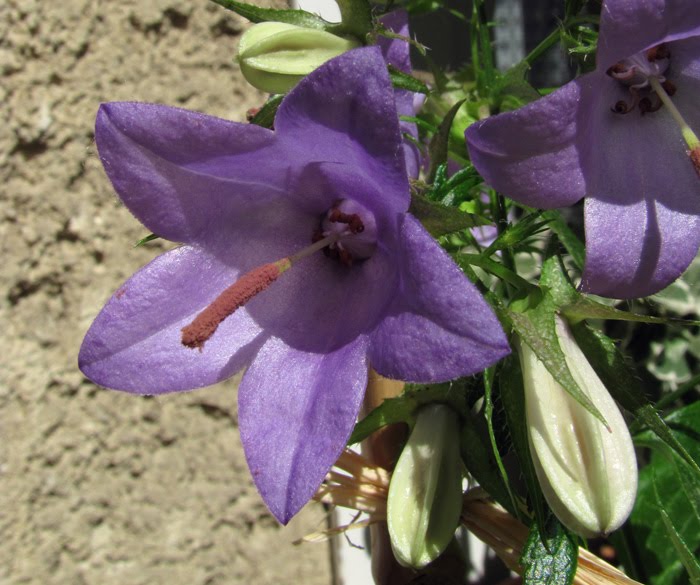
The flower bud is white, the flower itself has a lavenderlike color. It is 3 cm wide and 2 cm long. The pollen is orange-brown.


It makes many stolons, looks quite vigurous (aggressive?), but it is lovely, I like it. Here it is planted in a large clay pot together with Galanthus, Eranthis hyemalis, Hepatica nobilis and an Euonymus fortunei 'Emerald Gaiety'. They seem to like each other. In spring its leaves appear rather late so does not disturb the early flowers, and in summer it "drinks" the excess moisture from the bulbs and Hepatica. And its foliage makes a good shade in summer for the Hepatica's leaves.
According to G. Nicholls it is an easy plant and can be propagated by seed or cuttings. I will see.